[CoRL 2025] Humanoid Policy ∼ Human Policy
- Humanoid robot의 manipulation policy를 더 robust하고 generalize되게 만들려면 다양한 데이터로 학습하는 게 도움이 됨. 하지만 robot demonstration만으로 학습하면 데이터 수집이 labor-intensive하고, tele-operation이 필요해서 확장이 어려움
- 논문은 humanoid teleoperation을 인간 행동을 기하학적 변환이나 retargeting으로 로봇 동작에 매핑하는 과정으로 보고, robot을 human-centric representation으로 모델링하여 human action을 변환해 robot action을 얻는 관점을 제시
- egocentric task-oriented 데이터셋 PH2D를 수집하고, human과 humanoid를 통합된 state-action space에서 함께 학습하는 Human Action Transformer(HAT)를 제안하여, human 데이터와 robot 데이터를 co-training하는 방식을 제
Contribution
- PH2D 데이터셋 생성(large egocentric task-oriented human-humanoid dataset, 정확한 hand & wrist pose 포함)
- Human-humanoid Action Transformer (HAT)를 통해서 unified state-action space 및 other alignment techniques 도입
- 실험/ablations로 co-training human data의 이점(robustness/generalization)을 검증
Method
PH2D: Task-oriented Physical Humanoid-Human Data
- 기존의 egocentric human videos 는 non-task-oriented skills 에 대한 demonstraction을 제공하거나, imitation learning 을 위한 world-frame 3D head/hand poses 을 제공하지 않음
- PH2D는 위 두 문제를 해결하기 위해:
- Robot execution과 직접 관련된 task-oriented human demonstration 수집
- VR device의 SDK를 활용해 supervision 제공
- task, camera sensor 다양화 / whole-body movement 감소를 통해 vision/behavior domain gap 감소
Adapting Low-cost Commerical Devices
- Apple Vision Pro + Built-in Camera, Meta Quest 3 / Apple Vision Pro + ZED Camera 등 기존 상용 장비를 활용해서 데이터 취득하는데 활용
Data Collection Pipeline
- VR 장비 착용한 사람이 Robot execution과 겹치는 task 수행 (예: grasping, pouring)
- 각 demonstration마다 Language instruction 제공 (ex. "grasp a can of coke zero with right hand)
- Proprioception input과 visual input을 timestamp 기준으로 동기화
Action Domain Gap
- human과 tele-operated robot actions 는 두가지 다른 특성이 있음
- human manipulation은 whole-body movement가 포함되어 있음
→ 인간 데이터 수집 시 upright 자세로 앉도록 요청
- 인간이 로봇보다 훨씬 빠르고 dexterous, task completion time 차이 존재
→ 학습 중 human trajectory의 translation과 rotation을 interpolation하여 “slow down”
→ Slow-down factor: ( human과 humanoid의 평균 task completion time 비율을 정규화하여 계산. 경험적으로 약 4 )
→ 모든 task에 α_slow = 4 사용
- human manipulation은 whole-body movement가 포함되어 있음
HAT: Human Action Transformer
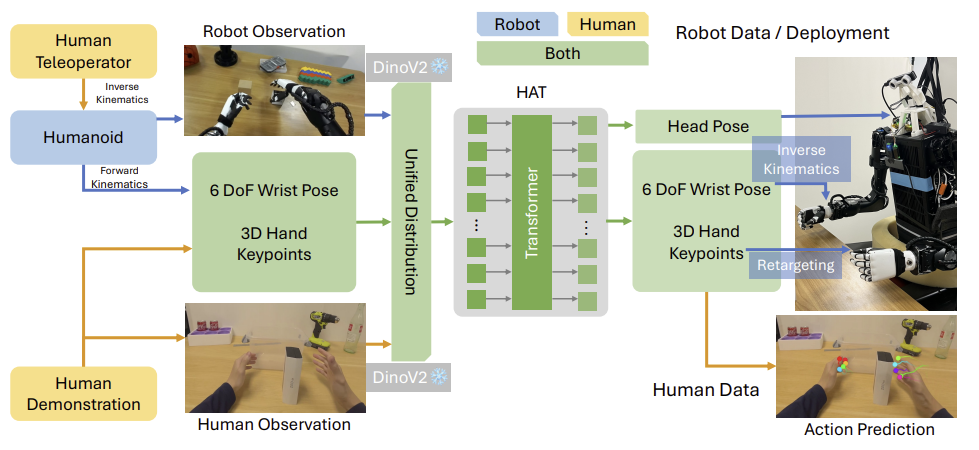
- HAT는 human을 모델링함으로써 cross-embodied robot policy를 학습
- bimanual humanoid robot과 human을 retargeting을 통해 서로 다른 embodiment로 취급하는 것이 HAT의 generalizability와 robustness를 개선한다고 주장
- 로봇데이터:
- : i 번째 demonstration 에 대한 proprioceptive , visual observations
- v : action
- 인간 데이터 (PH2D):
- 인간 데이터 수집 효율이 훨씬 높으므로
- time 에서 현재 robot observation 가 주어졌을때 future robot 을 예측하는 policy 를 학습하는것
- action은 multi-step 실행을 위한 action chunk로 구성됨
Unified State-Action Space
- human과 bimanual humanoid robot을 위해 통합된 state-action 공간을 설계
- Proprioceptive Observation은 총 54차원 벡터로 구성됨.
- Head, Left wrist, Right wrist의 6D rotation
- Left / Right wrist, 10개의 fingertip 의 x/y/z 위치
- 논문은 5-fingered dexterous hand를 사용하는 로봇에 deploy
- robot fingertip과 human fingertip 사이에 bijective mapping 존재
Visual Domain Gap
- Human–Robot co-training 시 두 가지 domain gap 존재
- Camera sensor 차이
- human 데이터 수집 카메라 ≠ robot deploy 카메라, tone 등 차이 발생
- End-effector appearance 차이
- human 손 vs humanoid 손 외형 차이
- Camera sensor 차이
- 다만, 충분히 크고 다양한 데이터가 있다면 visual artifact 추가나 generative 방법 없이도 기본적인 image augmentation(color jittering, Gaussian blurring) 만으로도 효과적인 regularization이 된다고 언급
Training
- final policy는 다음과 같이 쓸 수 있음
- : 파라미터 를 가진 transformer-based neural network
- 이 policy은 human과 robot 모두에 대해 동일하게 사용됨
- 최종 loss는 다음과 같이 정의
- : policy의 action prediction과 실제 action 간의 L1 loss
- EEF는 left/right wrist translation vector의 인덱스. 즉, 손목 위치(translation) 부분만 따로 뽑아 L1 loss를 계산
- : insensitive hyperparameter
- End effector position의 중요성을 더 강조하면서 불필요하게 정밀한 fingertip keypoint 학습에 과도하게 집중하는 것을 방지
- 손목 위치 정확도를 더 중요하게 학습하도록 설계되어 있다.
Experiment
Hardware Platforms
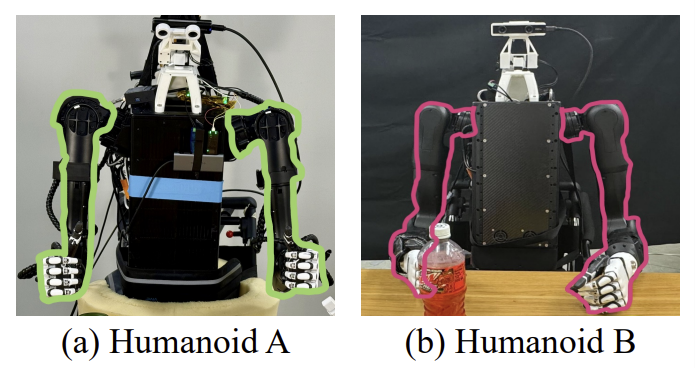
- 두 개의 humanoid robot 사용:
- Humanoid A: Unitree H1
- Humanoid B: Unitree H1 2 (다른 arm configuration)
- 두 로봇 모두 6DOF Inspire dexterous hand 장착, Actuated neck 보유 (egocentric view 활용 가능), Wrist camera 없음
- 대부분의 데이터 수집은 Humanoid A
- Humanoid B는 cross-humanoid generalization 테스트용

Implementation Details
- Transformer 기반 architecture 사용
- Visual backbone: Frozen DinoV2 ViT-S
- 두 가지 모델 구현:
- ACT (Baseline): Action Chunk Transformer, Robot data만 사용. Robot state는 joint positions
- HAT: ACT와 동일한 architecture. 하지만 state encoder는 unified state-action space. robot + human co-training. 각 task마다 250–400 robot demonstrations로 checkpoint 학습
Experimental Protocol
- In-Distribution (I.D.)
- Training robot demonstration과 유사한 scene setup
- Background, object type, placement 유사
- Out-of-Distribution (O.O.D.)
- Robot data에는 없지만 human data에는 있는 새로운 setup
- Generalization 및 robustness 평가 목적
Main Evaluation
Human data has minor effects on I.D. testing
- Human data co-training 유무에 따라 성능 거의 동일
- 소량 robot data만으로도 I.D.에서는 잘 동작
- Frozen visual foundation model이 lighting 등 perturbation에 강건하다는 최근 연구와 일치함
Human data improves the O.O.D. settings with many generalizations
- Co-training이 O.O.D. 성능을 drastically improve
- Robot data에 없던 setting에서 거의 100% relative improvement
- Human data가 향상시킨 일반화 유형: Background, Object placement, Appearance
- 각 task는 특정 generalization 유형에 집중하도록 설계
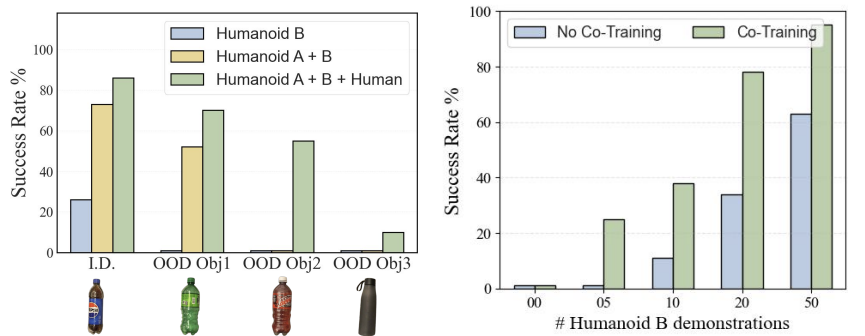
Few-Shot Transfer across Heterogeneous Embodiments
- Humanoid B에서 few-shot 실험 수행 (Humanoid A와 다른 embodiment + 다른 환경)
Experiment 1: Cross-embodiment co-training
- Humanoid B demonstration 20개만 사용해 3가지 정책 학습: (i) Humanoid B만, (ii) Humanoid B + Humanoid A, (iii) Humanoid B + Humanoid A + Human
- (ii), (iii)가 (i)보다 모든 task에서 성능 우수
- Embodiment 간 latent task structure 전이 가능함을 보여줌
Experiment 2: Few-shot scaling
- Humanoid A + Human dataset 고정, Humanoid B demonstration 개수만 변화
- Co-training (B + A + Human)이 모든 설정에서 단독 B 학습보다 우수. 특히 few-data regime에서 차이 큼